10 Key Steps OpenAI Is Taking to Label AI-Generated Images for Transparency
As artificial intelligence continues to blur the line between real and synthetic media, identifying the origin of images has become a pressing challenge. In response, OpenAI has unveiled two significant initiatives aimed at making AI-generated images easier to spot. By joining the Coalition for Content Provenance and Authenticity (C2PA) and adopting Google’s SynthID watermark, the company is taking a proactive stance on content transparency. This article breaks down the ten most important things you need to know about these developments, from how the technology works to its broader implications for online trust.
1. OpenAI Joins the C2PA Standard
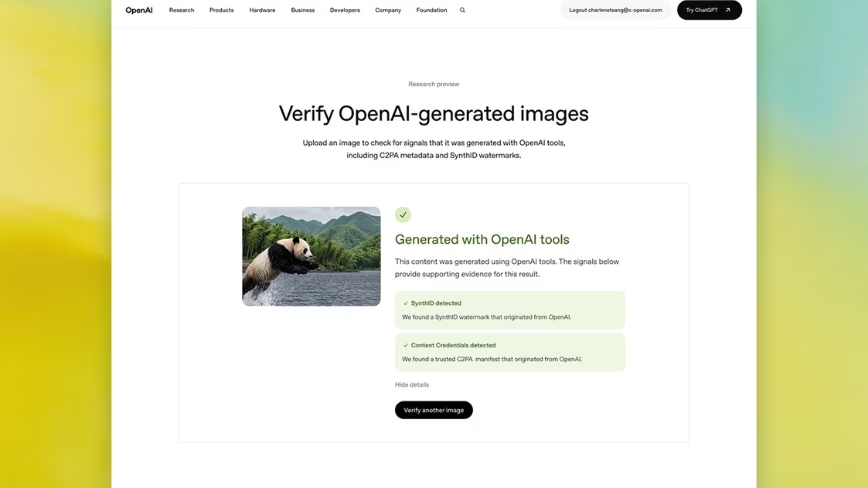
OpenAI has formally become a member of the Coalition for Content Provenance and Authenticity (C2PA), an open standard that provides a framework for verifying the origin of digital content. This means that images generated through OpenAI’s platforms, such as DALL-E, will now carry tamper-proof metadata detailing their creation. The C2PA specification is designed to be flexible, supporting multiple types of media, and works by embedding cryptographically signed provenance information into files. By adopting this standard, OpenAI hopes to give viewers a reliable way to check whether an image was made by an AI, even if the image is later downloaded or shared. This move aligns with a broader industry trend toward accountability, as other major tech companies like Microsoft and Adobe are also C2PA participants.
2. Partnership with Google for SynthID Watermarking
In addition to the C2PA standard, OpenAI is teaming up with Google to integrate the tech giant’s SynthID watermark into its image outputs. SynthID is an invisible digital watermark that is embedded directly into pixels without altering the image’s visual quality. Unlike traditional watermarks that can be cropped or removed, SynthID is designed to be resilient against common modifications such as resizing, compression, and color adjustments. This partnership marks a rare collaboration between two leaders in artificial intelligence, signaling a unified effort to combat deepfakes and misinformation. The watermark works by subtly tweaking pixel values in a pattern that can be detected by a dedicated AI algorithm, allowing automated systems to verify authenticity without human intervention.
3. How SynthID Stays Invisible Yet Detectable
SynthID employs a sophisticated technique to remain invisible to the human eye while being robustly detectable by machine learning models. It uses a two-stage process: first, a neural network generates a watermark pattern that is tailored to the content of the image, ensuring it blends naturally. Second, the watermark is layered onto the image at an imperceptible intensity. To verify an image, a separate detector model scans for these patterns, even if the image has been edited. This approach makes SynthID far more durable than visible logos or fragile metadata, which are easily stripped. Google developed SynthID internally for its own Imagen model, and now by sharing it with OpenAI, the technology gains wider deployment. This cross-company adoption underscores its potential as an industry-standard tool for AI content attribution.
4. What This Means for DALL-E Users
For anyone using OpenAI’s image generation tools, these changes will be mostly invisible yet impactful. Starting with DALL-E 3, every generated image will contain C2PA provenance metadata and, where supported, a SynthID watermark. Users won’t notice a difference in image quality or generation speed, but they will gain the ability to verify authenticity via third-party tools that read C2PA data. Additionally, the invisible watermark provides an extra layer of security that survives sharing on social media. This means content creators who use AI art will have stronger proof that the work is indeed AI-generated, which can help in copyright discussions. However, it also means that anyone attempting to pass off AI images as real photographs will find it harder to do so undetected.
5. Combatting Misinformation and Deepfakes
One of the primary motivations behind OpenAI’s moves is to curb the spread of visual misinformation. As text-to-image models become more realistic, the line between authentic and synthetic imagery grows thinner. Malicious actors could use AI to fabricate news events, fake evidence, or impersonate individuals. By embedding provenance data and invisible watermarks, OpenAI provides forensic tools that journalists, fact-checkers, and platform moderators can use to quickly assess an image’s origin. While not foolproof—determined adversaries might still strip watermarks or forge metadata—these measures raise the technical bar. They also promote a culture of transparency, encouraging users to be more critical about the images they encounter. The ultimate goal is to help society adapt to an era where seeing is no longer believing.
6. The Limitations of Current Technology
No watermark or metadata is completely invulnerable. C2PA metadata can be removed by simple file conversion or screenshot capture, and SynthID may be degraded by heavy editing like extreme filters or cropping. Moreover, both methods rely on the cooperation of downstream platforms to preserve and verify the information. If social media sites strip metadata during upload, the provenance trail is lost. OpenAI acknowledges these limitations and emphasizes that these measures are just one layer in a broader defense strategy. The company continues to invest in other areas such as content moderation, user education, and detection research. The challenge is staying ahead of adversarial techniques, which evolve rapidly. As such, these announcements should be seen as a necessary but not final step toward a trustworthy AI ecosystem.
7. Comparing C2PA and SynthID
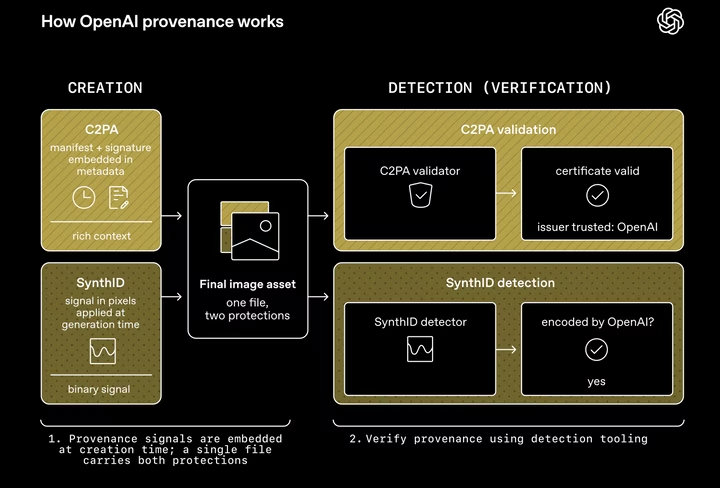
Though complementary, C2PA and SynthID serve different purposes. C2PA is a metadata standard that attaches a cryptographically signed provenance record to the file, much like a digital certificate. It requires the file format to support such metadata (e.g., PNG, JPEG with EXIF). SynthID, on the other hand, is a steganographic watermark embedded in the image’s pixel data, making it more resilient to reformatting. C2PA provides detailed information (model used, creation date, etc.) but is easier to strip; SynthID is harder to remove but only indicates AI origin without extra details. Together, they create a layered identification system: C2PA for comprehensive provenance when metadata is intact, and SynthID as a fallback that survives casual manipulation. OpenAI’s adoption of both gives the public multiple ways to verify content, depending on how the image has traveled.
8. Industry-Wide Impact and Adoption
OpenAI’s decision to adopt C2PA and SynthID may encourage other AI companies to follow suit. The coalition already includes major players like Adobe, Microsoft, and Intel, but many generative AI startups remain reluctant to impose such transparency measures, citing user experience concerns or technical overhead. By setting a high bar, OpenAI is putting pressure on competitors to match its level of accountability. Additionally, the partnership with Google could lead to a unified de facto standard for AI watermarks. Regulators in the European Union and the United States are increasingly calling for mandatory labeling of AI-generated content, making voluntary steps like these a potential roadmap for future legislation. If adopted widely, the combination of provenance metadata and invisible watermarks could become the norm, much like the copyright metadata found in digital cameras.
9. A Multi-Layered Approach to Transparency
OpenAI is not relying solely on technology to solve the identification problem. Alongside C2PA and SynthID, the company is updating its usage policies, investing in research on detection algorithms, and collaborating with academic institutions studying misinformation. It also plans to engage with social media platforms to encourage preservation of provenance data. This multi-layered approach recognizes that no single solution is enough. While the watermark and metadata target the technical side, policy and education address human behavior. For example, OpenAI is developing best practices for sharing AI-generated content and urges users to always disclose AI involvement. By combining tools, rules, and awareness, the company aims to build a trust framework that keeps pace with the rapid advancement of generative AI.
10. The Future of AI Image Attribution
Looking ahead, the tools announced today are likely to evolve. OpenAI and Google are already exploring next-generation watermarks that could survive video compression and audio transcoding. There is also ongoing research into “deep” watermarks that are inextricably linked to the image’s semantics, making removal nearly impossible without destroying content. Moreover, as cameras and AI generation devices become ubiquitous, embedding provenance at the point of creation—whether in a smartphone camera or an AI model—could become standard. The dream is a reliable “nutrition label” for every image, automatically verified by browsers and social platforms. While we are still years away from universal adoption, OpenAI’s moves represent a critical first step. They demonstrate that even leading AI labs are willing to sacrifice some anonymity for the sake of social responsibility.
In conclusion, OpenAI’s adoption of the C2PA standard and Google’s SynthID watermark marks a turning point in the fight against digital deception. By providing both visible and invisible methods to identify AI-generated images, the company empowers users, journalists, and platform moderators to make informed judgments. No solution is perfect, but this layered approach raises the bar for transparency across the industry. As generative AI continues to evolve, such proactive measures will be essential to preserving trust in what we see online. The journey toward authentic digital content has just begun, but these ten points highlight why the future looks more accountable than before.