Simulation-First Manufacturing: How OpenUSD and AI Are Reshaping Production
Introduction
For decades, manufacturing relied on a simple yet costly principle: real-world testing was the only way to truly validate a design. Engineers would build physical prototypes, test them, and iterate—a cycle that consumed time, material, and money. But that era is giving way to a simulation-first approach, where high-fidelity digital environments not only replicate reality but also generate synthetic training data precise enough for production-grade AI. At the heart of this transformation is OpenUSD, a universal standard for 3D data exchange, and the NVIDIA Omniverse platform, which provides the physics-accurate simulation layer needed to train and validate AI models before they ever touch a factory floor.
The Shift to Simulation-First
Traditional design-build-test cycles assumed that only physical trials could uncover edge cases—lighting changes, material variances, or unexpected robot behaviors. However, modern simulation tools now generate synthetic variations at scale, covering scenarios that would be impractical to test manually. This enables perception systems, reasoning models, and agentic workflows to excel in live production environments. OpenUSD emerges as the connective tissue that makes this practical, allowing assets to move seamlessly between computer-aided design (CAD), rendering, and simulation tools without losing critical physics properties, geometry, or metadata.
SimReady: The Content Standard for Physical AI
A foundational challenge has been that 3D assets rarely travel reliably across different pipelines. Every transfer from a CAD tool to a simulation platform risks dropping physics properties or metadata, forcing teams to rebuild from scratch. SimReady, built on OpenUSD, defines what physically accurate 3D assets must contain to work reliably across rendering, simulation, and AI training. NVIDIA Omniverse libraries then provide the physics-accurate, photorealistic layer where AI models are trained and validated before deployment. This standard is critical as physical AI becomes integral to industrial operations, from robotic arms to autonomous vehicles.
Real-World Applications of the NVIDIA Physical AI Stack
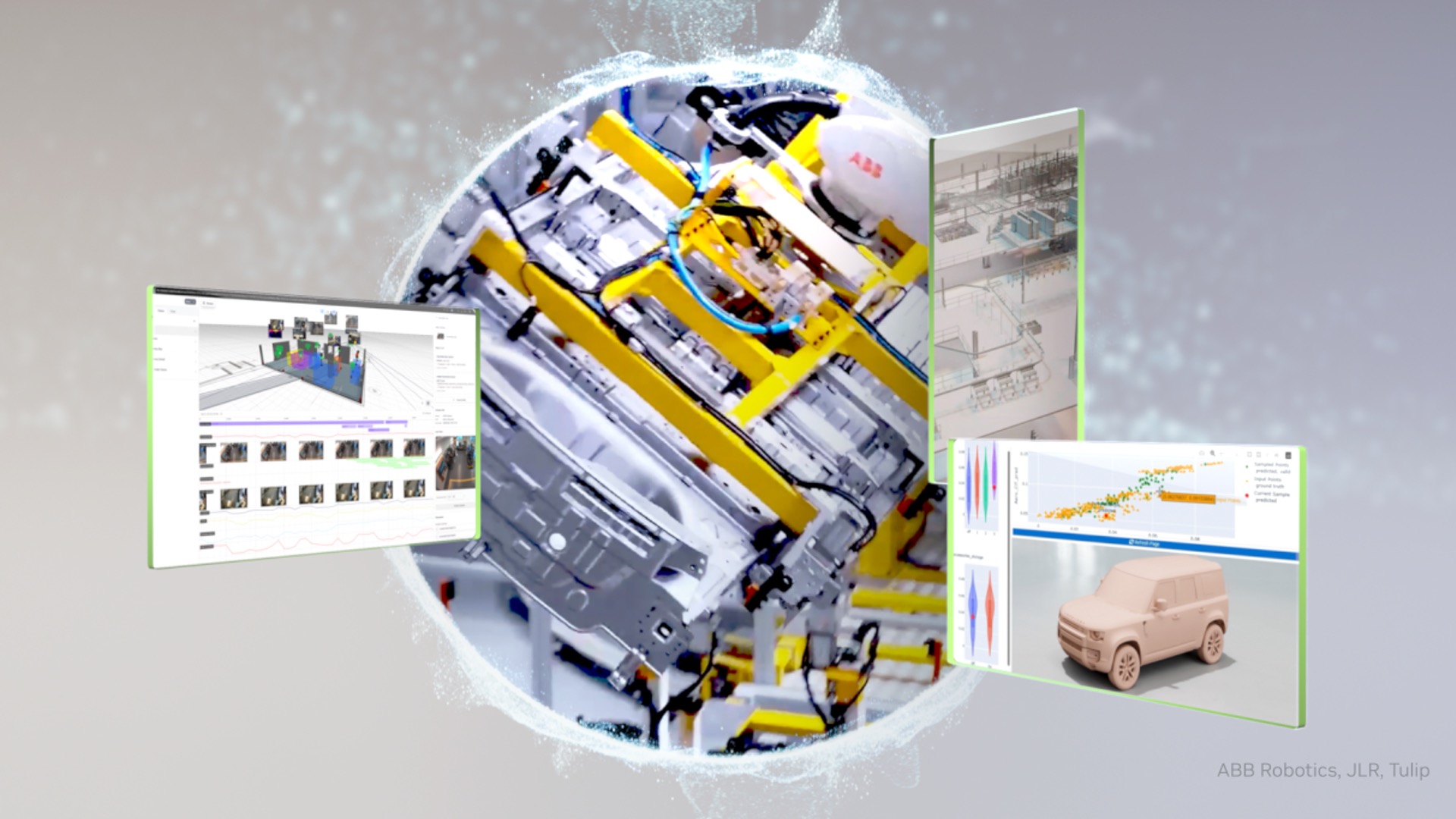
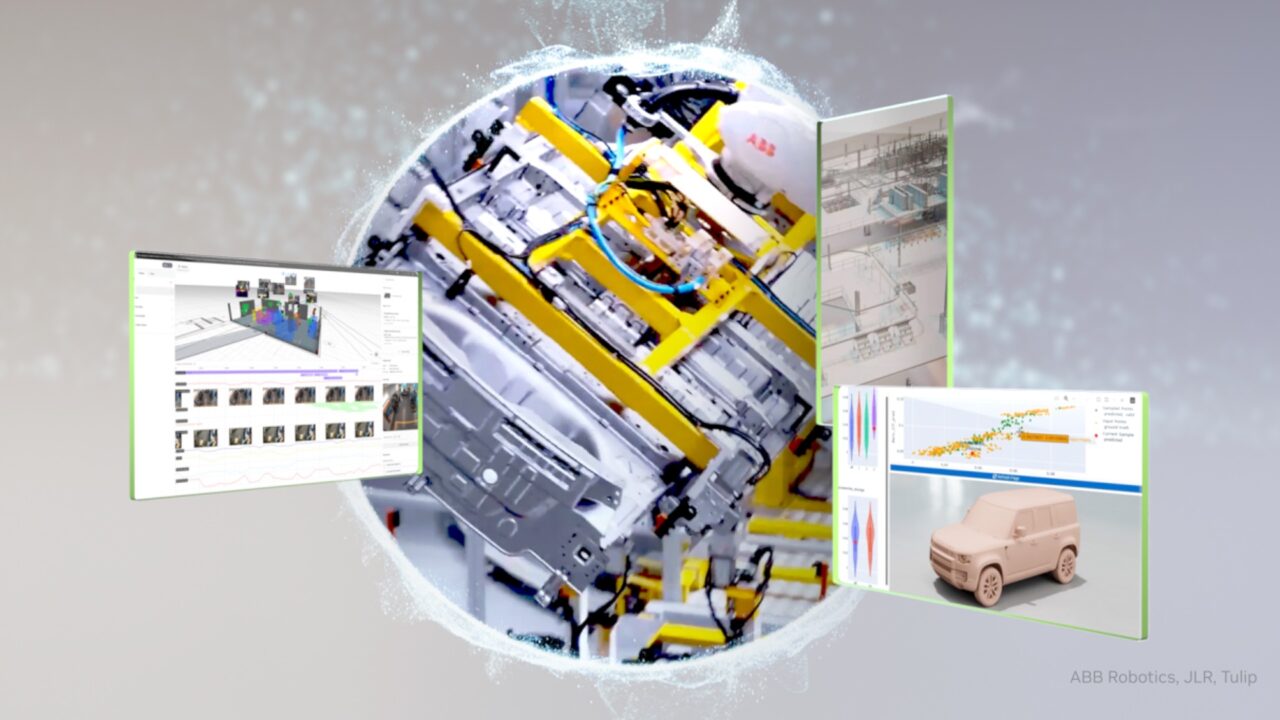
Manufacturers are already putting this stack to work, with measurable results. Two examples illustrate the power of simulation-first thinking: ABB Robotics in robot simulation and JLR in vehicle aerodynamics.
ABB Robotics: Closing the Sim-to-Real Gap at 99% Accuracy
ABB Robotics integrated NVIDIA Omniverse libraries directly into RobotStudio HyperReality, its simulation platform used by over 60,000 engineers worldwide. The platform represents robot stations as USD files running the same firmware as their physical counterparts. This allows training robots, testing part tolerances, and validating AI models before a production line even exists. Synthetic training variations—such as lighting conditions and geometry differences—can be generated at scale, covering edge cases that would be too costly to create manually.
According to Craig McDonnell, managing director of business line industries at ABB Robotics, “We’ve managed to vertically integrate the complete technology stack and optimize it to a point where we’re now achieving 99% accuracy on the simulated version.” The downstream outcomes are striking: up to 50% reduction in product introduction cycles, up to 80% reduction in commissioning time, and a 30-40% reduction in total equipment lifecycle cost. These gains stem from catching design flaws early and optimizing workflows before physical hardware is ever built.
JLR: Compressing Aerodynamic Simulation from Four Hours to One Minute
Jaguar Land Rover (JLR) applied a similar simulation-first principle to vehicle aerodynamics. Engineers trained neural surrogate models on more than 20,000 wind-tunnel-correlated computational fluid dynamics (CFD) simulations across their vehicle portfolio. These surrogate models, running on NVIDIA GPUs, now handle 95% of aero-thermal workloads. What once took four hours of computation is now completed in just one minute—a 240x speedup. This enables JLR to explore far more design iterations during the vehicle development process, optimizing for drag reduction, thermal management, and fuel efficiency without the time and cost of physical wind tunnel tests.
The simulation-first approach also allows engineers to test extreme conditions—such as high-speed crosswinds or desert heat—that would be difficult or dangerous to replicate physically. By starting in the digital world, JLR shortens the design cycle and reduces the number of physical prototypes needed.
The Future of Manufacturing
As more manufacturers adopt simulation-first workflows, the impact will extend beyond robotics and aerodynamics. OpenUSD’s role as a standard for asset interchange will enable entire supply chains to collaborate on digital twins, synchronizing design, production, and maintenance. With tools like SimReady ensuring consistency, and platforms like Omniverse providing the simulation backdrop, the manufacturing industry is poised to reduce waste, accelerate innovation, and build more resilient production systems. The era of simulation-first is no longer a promise—it’s already delivering results.