The AI Revolution in Software Development: Reshaping Tools, Roles, and Lifecycles
Introduction
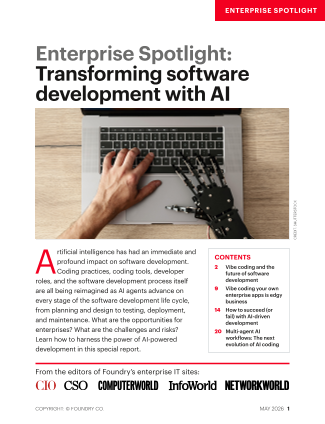
Artificial intelligence has ushered in a transformative era for software development, fundamentally altering how code is written, tested, and maintained. From automating mundane tasks to enabling entirely new workflows, AI agents are now active participants in every phase of the software development lifecycle (SDLC). This article explores the key changes AI is driving in coding practices, developer roles, and the overall development process, and offers insights from the latest Enterprise Spotlight publication.

AI-Powered Coding Practices and Tools
From Autocomplete to Autonomous Agents
Traditional coding tools offered limited assistance, such as syntax highlighting and basic autocomplete. Today, AI-powered code assistants leverage large language models to suggest entire functions, generate boilerplate code, and even write complex modules from natural language descriptions. Tools like GitHub Copilot and Amazon CodeWhisperer are now commonplace, dramatically accelerating the initial coding process.
Impact on Productivity and Code Quality
These AI assistants not only speed up development but also help reduce human error. By analyzing millions of code repositories, they can suggest best practices, detect potential bugs early, and propose optimizations. However, developers must still review AI-generated code for security vulnerabilities and alignment with project requirements. The result is a partnership where humans handle high-level logic and AI handles repetitive or well-understood patterns.
The Evolving Role of Developers
From Coders to Orchestrators
With AI taking over significant portions of coding, the role of the developer is shifting from writing every line of code to orchestrating AI agents and reviewing their output. Developers now spend more time on architecture design, prompt engineering, and integration testing rather than rote implementation. This transition demands a broader skill set that includes understanding how to specify tasks effectively for AI and how to validate AI contributions.
New Skills Required
To thrive in this AI-augmented environment, developers need to cultivate skills in critical thinking, system design, and AI model ethics. Familiarity with machine learning concepts, data preparation, and model evaluation is becoming increasingly valuable. Furthermore, soft skills like communication and collaboration are more important as cross-functional teams leverage AI tools collectively.
Transforming the Software Development Lifecycle
Planning and Design
AI assists in the early stages by analyzing user stories, generating requirement specifications, and even proposing system architectures based on historical data. Natural language processing (NLP) models can extract key requirements from documents and suggest design patterns, reducing ambiguity and accelerating the planning phase.
Testing and Deployment
AI-driven testing tools automatically generate test cases, identify edge cases, and prioritize tests based on risk. During deployment, AI can monitor deployment scripts and rollback automatically if anomalies are detected. This reduces human oversight and improves deployment reliability.
Maintenance and Evolution
Post-deployment, AI models analyze logs, monitor application performance, and predict failures before they occur. They can also suggest code patches for known issues, perform automated refactoring, and even migrate legacy code to modern frameworks. This continuous learning loop ensures that software evolves efficiently with minimal human intervention.
Challenges and Considerations
While AI offers immense benefits, it also introduces challenges. Security risks arise from AI-generated code that may contain subtle vulnerabilities. Ethical concerns include bias in training data leading to biased outputs. Intellectual property questions also surround code produced by AI models trained on public repositories. Developers and organizations must establish governance frameworks to address these issues while harnessing AI’s potential.
The Future of AI in Development
As AI agents become more sophisticated, we can expect deeper integration into the SDLC, including AI-driven project management, automated code reviews, and even fully autonomous development for simple applications. The developer's role will continue to evolve toward strategic oversight and creative problem-solving. To stay ahead, teams should invest in training and tooling that leverage AI while maintaining rigorous quality standards.
Conclusion
The transformation of software development by AI is not a distant future—it is happening now. By embracing AI-enabled development practices, organizations can boost productivity, improve code quality, and empower their developers to focus on higher-value tasks. For a deeper dive into these trends and practical strategies, download the May 2026 issue of the Enterprise Spotlight from the editors of CIO, Computerworld, CSO, InfoWorld, and Network World. Learn how to harness the power of AI-enabled development and stay competitive in the evolving landscape.